
Less Bootcamp, More Dancing
Lessons from building a poetry community

A few weeks ago I woke up at 2am worrying about the online poetry community I was trying to build. I’d been thinking and planning for a year or so, but finally putting my ideas into practice had become a huge struggle. Almost everything (the signup page, new resources and posts, editing video, organising the space, making it all as accessible as possible) took more time and effort than I’d imagined. I had a small, heroic, dedicated test team of members, all of whom I’d taught in other contexts, and they told me they liked and valued the space and resources—but it wasn’t a community. Months after my original planned launch date, I still wasn’t ready to properly launch. I’d asked fifty or so poets for their feedback on what I was offering. People were positive and helpful but often confused or uncertain. Who was the community designed for, exactly? Beginners? More advanced poets? What did it offer that wasn’t available from peer meet-up groups or on instagram for free?
I haven’t written a poem for 18 months or so, which is probably the longest haitus in my poetry writing since I began to write regularly as a teenager. Since giving birth to my son four and a half years ago I’ve written very little original poetry in the traditional sense—though I have woven together and edited Pretenders, a collection that includes prose fragments and draws heavily on voices from recorded interviews. In between childcare and building up a solo-mum-friendly freelance career, there hasn’t been much time or brain space for my own creativity. The earliest stages of parenthood, despite the sleep deprivation, allowed me slow down: to think about and process experience in a deep, embodied way that I hadn’t felt able to access (so consciously, at least) for a long time. I don’t think this is particular to childbearing or childcare. It’s just that I was, for once, not juggling multiple jobs or working late every evening—and I was engaged in a kind of labour where being emotionally present really matters. I think this is where the creative force and determination behind Pretenders came from, but since the end of maternity leave my working life has felt like a constant marathon.
The earliest stages of parenthood… allowed me slow down: to think about and process experience in a deep, embodied way that I hadn’t felt able to access (so consciously, at least) for a long time. I don’t think this is particular to childbearing or childcare. It’’s just that I was, for once, not juggling multiple jobs…
I’m determined not to let parenthood and my move to Gloucestershire herald the end of my writing and teaching careers, so I’ve been on a quest to find ways to continue to do the work I love while supporting my small family. I’m mentoring some fabulous writers, editing some great books, teaching and discussing brilliant writing, crafting and moulding language in ways that feel energising and exciting. My online poetry community Poetical Workshop was supposed to be part of this and, in some ways, to bring it all together. I decided I wanted to make something for poets who, like me, might struggle to find time and space to write This is where I got lost, I think—in the struggle. I developed an online workshop designed to help poets to keep writing: regular prompts, lots of learning resources, motivation... None of this is, in itself, a bad thing. What I eventually realised is that I was offering both too much and not enough.
If someone genuinely doesn’t have enough time and brain space to write poetry, no class or community will fix this. It’s a social, economic and cultural problem I can do very little about. Also: (most) poets want to be seen and heard and. In the absence of three-dimensional interaction, and in an ongoing community (as opposed to a class), finding ways to make this happen is vital. The flexibility and accessibility of online and on-demand learning is attractive to many people, especially if they’re busy and on the move, but they don’t just want to be motivated to survive as poets and keep their practice going, like poetry marathon runners—they want to learn, progress, improve their understanding of craft, technique, feedback and revision, develop their perspective and voice, get out of their comfort zone, play, share their work with their peers and through performance or publication… Poets joining the kind of online community I’m going to be best at providing want (of course) the same things that poets I teach and mentor want— which is what I’m highly qualified to give and what I’ve spent the last 20 years doing.
Poets don’t just want to be motivated to survive as poets and keep their practice going, like poetry marathon runners—they want to learn, progress, improve their understanding of craft, technique, feedback and revision, develop their perspective and voice, get out of their comfort zone…
A well-planned, well-organised online community with a sustainable rhythm gives me the opportunity to support more poets, and to offer the ongoing peer support, camaraderie and cross-pollination that one-to-one mentoring alone can’t give. It’s not about ‘passive income’ (at the moment, I can’t think of anything less passive) and it’s not an apparatus for delivering learning resources. After much feedback, honing and redesigning, the workshop is now becoming a space for flexible, accessible, genuinely interactive group mentoring—much more than ‘keeping going.’ And this has got me thinking differently about my own writing, too. More hopeful exploration of possibilities, even if it’s (so far) just in my head and not on the page.
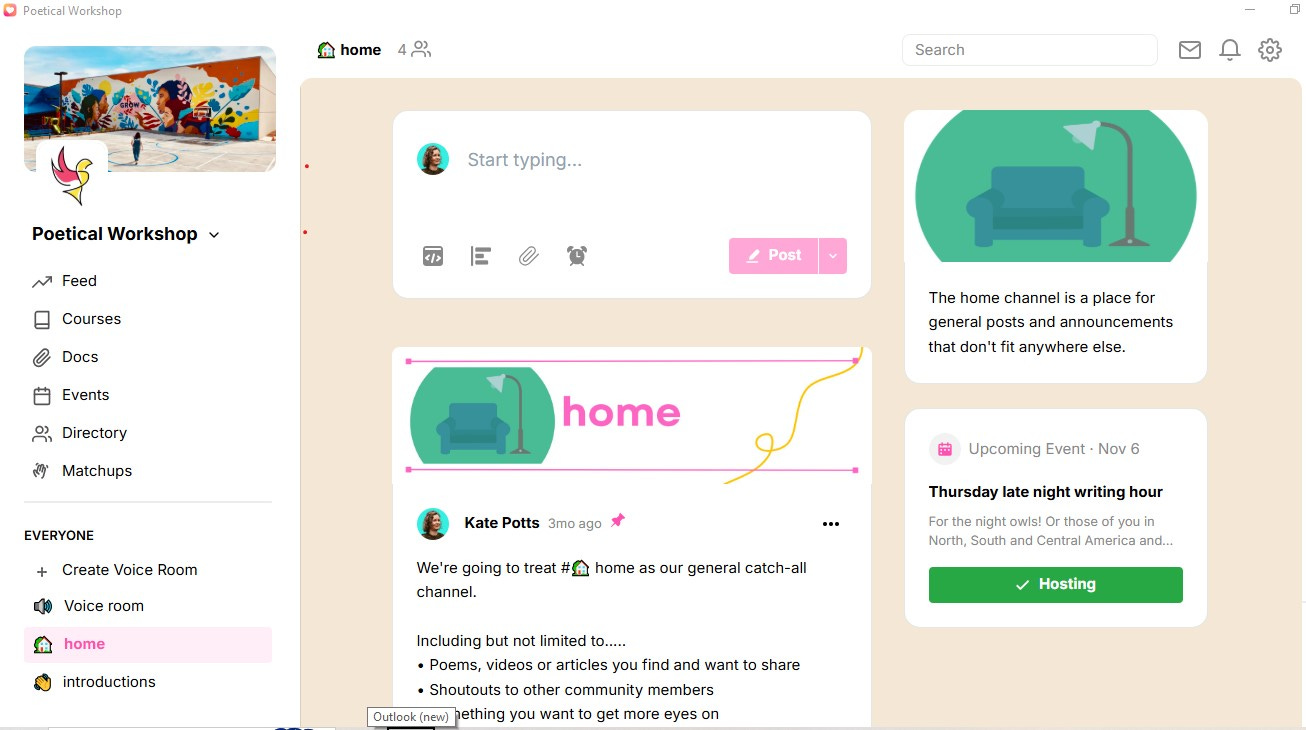
With all this in mind, I’m starting small: opening up registration for a Founding Circle group that can help shape the workshop community as it grows.
Poets can sign up for the waiting list now. On January 2nd, the community will open for up to 25 Founding Circle members—all of whom will get a 20% lifetime discount on their subscription and 30 minutes of one-to-one mentoring with me, so I can make sure I know how I can best support them. January’s on-demand craft session will be on ‘writing the body’ and Founding Circle members will get exclusive access to Sarah Howe’s wonderful guest poet prompt on touch. For poets who struggle to maintain their writing practice there’s The Groundwork, a free course full of helpful advice and guidance on how to develop a poetry practice that’s sustainable even when you have a lot on your plate. I’ll be sharing some Poetical resources for free here and elsewhere. But building a sustainable practice is only a part of the whole picture, not the main focus. I’m hoping the community can help poets make a positive commitment to their writing for the new year ahead.

Last weekend my son and I bought a large flashing-light disco ball tree decoration, hung it from the ceiling, put the lights out and Christmas party music on, and had a really good dance. There’s playfulness and joy in so much of what we do together and, on a good day, this is true of my working life too. I realise how lucky this makes me. The work I do with the writers I teach and with my mentees isn’t simply transactional—it’s more complex and relational than that. More like, for example, dancing.
Here are a few of my favourite poems about dancing:
‘The Dancing’ by Gerald Stern. Emigrant dancing in Pittsburgh, 1945. ‘The world at last a meadow…’
‘Some Bright Elegance’ by Kayo Chingonyi. Dancing as complex, bittersweet—performance and transcendence. ‘I say dance not to be seen, but free…’
‘Dancing on the Grave of a Son of a Bitch’ by Diane Wakoski. Unabashed and comic rage in a dance rhythm.
‘Dancing Toward Bethlehem’ by Billy Collins. ‘I would like to be dancing it slowly with you,/ say, in the ballroom of a seaside hotel…’
More from me soon. For now, happy dancing/writing!
Wishing you every success with your new workshop community!